PyPTO IR Overview
Overview
PyPTO is a compiler framework for AI accelerators. Users describe computation programs using the Python DSL, which then flows through the compilation pipeline to produce C++ kernel code that runs on the target hardware.
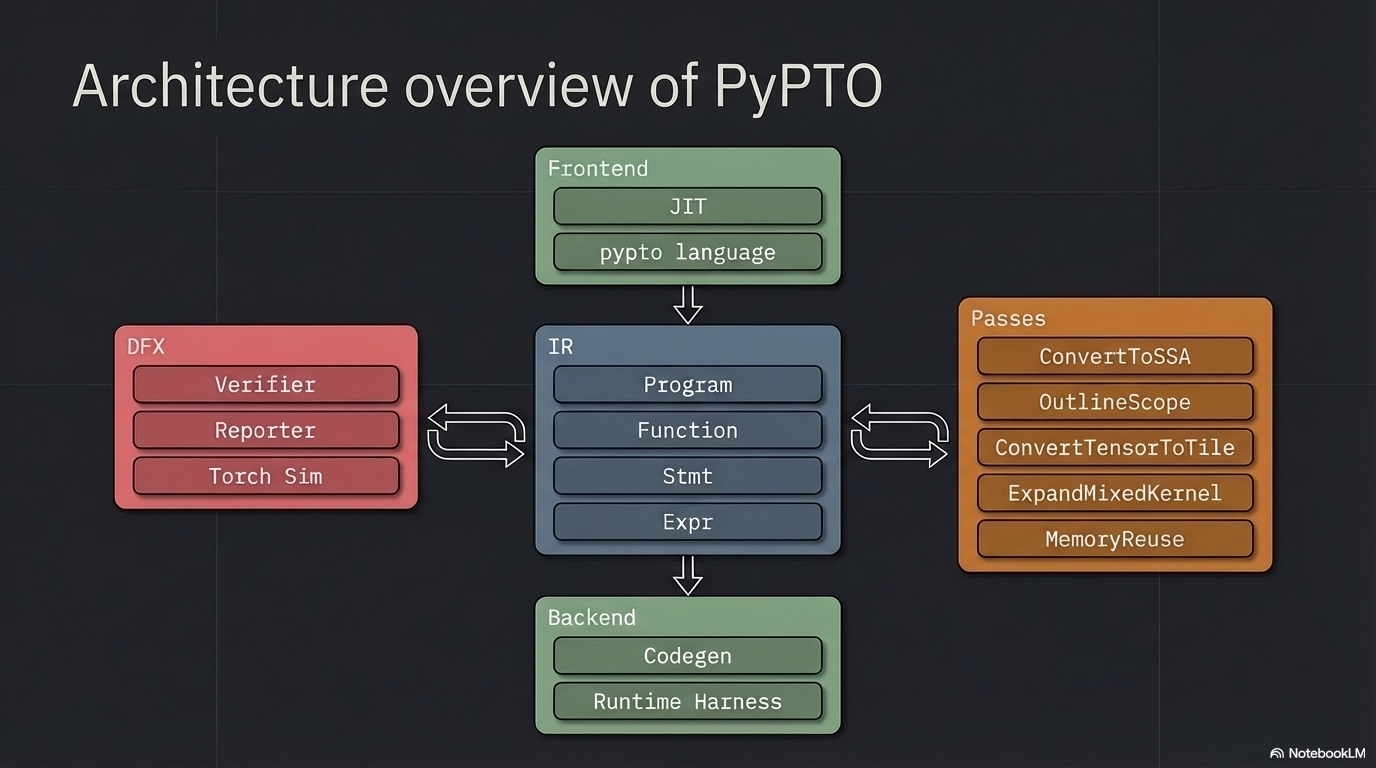
The compilation pipeline is organized into four main layers:
| Layer | Description |
|---|---|
| Python DSL | Users describe computation logic via @pl.program / @pl.function |
| IR | Immutable tree structure that spans the entire compilation process |
| Pass Pipeline | A sequence of transformation passes that progressively lower the IR toward code-generatable form |
| CodeGen | Generates InCore/Cluster kernel C++ and Orchestration C++ |
PyPTO's Intermediate Representation (IR) is a tree-based, immutable data structure used to represent programs during compilation. The IR serves as the foundation for program transformation, optimization, and code generation.
Key Design Principles:
- Immutability: All IR nodes are immutable once constructed
- Tree Structure: Forms a DAG where nodes can be shared across multiple parents
- Shared Pointers: All nodes managed through
std::shared_ptr<const T> - Reference Equality: Default
==compares pointer addresses; usestructural_equal()for structural comparison
Core Concepts
Source Location Tracking
Every IR node contains a Span object tracking its source location. Spans are used in two error-reporting paths:
- Verification diagnostics — verifier passes record
op->span_intoDiagnosticobjects (see IR Verifier) - Internal assertion checks —
INTERNAL_CHECK_SPANembeds the span intoInternalErrormessages (see Error Handling)
from pypto import ir

# Create a span for source location tracking
span = ir.Span("example.py", 10, 5, 10, 20)
print(span.filename)      # "example.py"
print(span.begin_line)    # 10

# Create unknown span when location unavailable
unknown_span = ir.Span.unknown()
Field Descriptors and Reflection
IR nodes use a reflection system for generic traversal. Each node defines three types of fields:
| Field Type | Purpose | Example Usage |
|---|---|---|
| IgnoreField | Ignored during traversal | Span (source location) |
| DefField | Definition fields introducing new bindings | Loop variables, assignment targets |
| UsualField | Regular fields traversed normally | Expression operands, statement bodies |
// Example: AssignStmt field descriptors
static constexpr auto GetFieldDescriptors() {
  return std::tuple_cat(
    Stmt::GetFieldDescriptors(),
    std::make_tuple(
      reflection::DefField(&AssignStmt::var_, "var"),      // Definition
      reflection::UsualField(&AssignStmt::value_, "value") // Normal field
    )
  );
}
Type Identification with Kind Mechanism
PyPTO IR uses an efficient Kind-based type identification mechanism to avoid the overhead of C++ RTTI (dynamic_cast). This provides O(1) type checking and casting with zero runtime overhead.
ObjectKind Enumeration
All IR node types are represented in a unified enumeration:
| Category | Kinds |
|---|---|
| Base | IRNode, Expr, Stmt, Type |
| Expressions | Var, IterArg, Call, TupleGetItemExpr, ConstInt, ConstFloat, ConstBool |
| Binary Ops | Add, Sub, Mul, FloorDiv, FloorMod, FloatDiv, Min, Max, Pow, Eq, Ne, Lt, Le, Gt, Ge, And, Or, Xor, BitAnd, BitOr, BitXor, BitShiftLeft, BitShiftRight |
| Unary Ops | Abs, Neg, Not, BitNot, Cast |
| Statements | AssignStmt, IfStmt, YieldStmt, ReturnStmt, ForStmt, SeqStmts, EvalStmt, InlineStmt |
| Types | UnknownType, ScalarType, ShapedType, TensorType, TileType, TupleType, PipeType |
| Other | Function, Program, Op, GlobalVar |
GetKind() Virtual Method
Every IR node implements the GetKind() method:
class IRNode {
 public:
  [[nodiscard]] virtual ObjectKind GetKind() const = 0;
};

class Var : public Expr {
 public:
  [[nodiscard]] ObjectKind GetKind() const override {
    return ObjectKind::Var;
  }
};
Type Checking with IsA<T>()
Use IsA<T>() to check if a node is of a specific type:
#include "pypto/ir/kind_traits.h"

ExprPtr expr = ...;

// Check if expr is a Var
if (IsA<Var>(expr)) {
  // expr is a Var
}

// Check if expr is a ConstInt
if (IsA<ConstInt>(expr)) {
  // expr is a ConstInt
}

// Works with TypePtr too
TypePtr type = expr->GetType();
if (IsA<TileType>(type)) {
  // type is a TileType
}
Type Casting with As<T>()
Use As<T>() to safely cast nodes to their concrete types:
#include "pypto/ir/kind_traits.h"

ExprPtr expr = ...;

// Cast to Var (returns nullptr if not a Var)
if (auto var = As<Var>(expr)) {
  std::cout << "Variable name: " << var->name_hint_ << std::endl;
}

// Cast ConstInt
if (auto const_int = As<ConstInt>(expr)) {
  std::cout << "Integer value: " << const_int->value_ << std::endl;
}

// Type casting
TypePtr type = expr->GetType();
if (auto tile_type = As<TileType>(type)) {
  // Access tile-specific properties
  auto shape = tile_type->GetShape();
}
Key Benefits:
- O(1) Performance: Single virtual function call vs. multiple
dynamic_castattempts - Type Safe: Returns
nullptron failed cast, no exceptions - Clean Syntax:
IsA<T>()andAs<T>()are more readable thandynamic_pointer_cast - Zero Overhead: Compiler can optimize away virtual calls in many cases
IRNode - Base Class
class IRNode {
  Span span_;                           // Source location (IgnoreField)
  virtual ObjectKind GetKind() const;   // Returns node's kind for O(1) type checking
  virtual std::string TypeName() const; // Returns node type name (for debugging)
};
All IR nodes inherit from IRNode and must implement:
GetKind(): Returns the node'sObjectKindfor type identificationTypeName(): Returns a human-readable type name (e.g., "Var", "AssignStmt")
Expression Base Class
All expressions produce a value with an associated type.
Statement Base Class
Statements represent program actions like assignments, control flow, and loops.
Type Base Class
Types describe the structure and properties of data in the IR.
Python Usage Pattern
from pypto import DataType, ir

# Create basic IR nodes
span = ir.Span.unknown()
dtype = DataType.INT64

# Variables
x = ir.Var("x", ir.ScalarType(dtype), span)
y = ir.Var("y", ir.ScalarType(dtype), span)

# Constants
one = ir.ConstInt(1, dtype, span)
pi = ir.ConstFloat(3.14, DataType.FP32, span)
flag = ir.ConstBool(True, span)

# Expressions
sum_expr = ir.Add(x, one, dtype, span)
product = ir.Mul(x, y, dtype, span)

# Statements
assign = ir.AssignStmt(x, sum_expr, span)
Design Philosophy
Immutability Benefits:
- Thread-safe sharing across transformations
- Structural sharing reduces memory usage
- Safer reasoning about program semantics
Kind Mechanism Benefits:
- Fast type checks without RTTI overhead
- Enables efficient visitor patterns
- Supports generic transformations and analyses
Reflection System Benefits:
- Generic tree traversal without code duplication
- Structural equality and hashing
- Pretty printing and serialization
Related Documentation
- IR Node Hierarchy - Complete node type reference
- IR Types and Examples - Type system and usage examples
- Structural Comparison - Equality and hashing utilities
Summary
PyPTO IR provides:
- Immutable tree structure for safe transformations
- Efficient type identification via Kind mechanism with O(1) performance
- Reflection-based traversal enabling visitors, mutators, and structural comparison
- Python-friendly API for IR construction
- Source location tracking for error reporting
- Three-tier field system (Ignore, Def, Usual) for flexible traversal